

Challenge
A specialty pharmaceutical company was preparing a 505(b)(2) New Drug Application submission for a biologic-compatible prefilled syringe system. The container closure system (CCS) was classified by FDA as high-risk (Category 1) — parenteral route, long-term storage, biologic sensitivity — which triggers the most stringent extractables and leachables (E&L) expectations under USP <1663> (extractables) and USP <1664> (leachables).
The sponsor's contract testing lab had proposed a generic E&L protocol based on legacy solvent extraction conditions and a truncated analytical panel. The sponsor's regulatory affairs function flagged three concerns: (1) the solvent set did not bracket the drug product's physicochemical profile (pH, ionic strength, biologic compatibility); (2) the analytical coverage did not extend to volatile, semi-volatile, and non-volatile compounds at FDA's expected Analytical Evaluation Threshold (AET); and (3) the leachables strategy lacked a defensible extractables-to-leachables bridging plan.
The sponsor engaged Chemva to author a comprehensive, risk-based E&L study design aligned with ISO 10993-18, USP <1663>, and USP <1664>, tailored to the sponsor's specific CCS configuration and drug formulation — before the contract lab committed analytical resources to an inadequate protocol that would need to be repeated.
USP <1663> / <1664> Expectations for High-Risk Parenteral CCS
FDA classifies parenteral drug product container closure systems on a risk matrix combining route of administration, dosage form, biologic sensitivity, and expected shelf life. High-risk (Category 1) configurations — prefilled syringes, infusion bags, inhaled formulations — face the most demanding E&L expectations and the tightest analytical thresholds.
USP <1663>: Extractables Assessment
USP <1663> establishes the expectations for component-level extractables characterization: solvent selection, extraction condition design (exhaustive, simulated, or controlled), analytical evaluation threshold (AET) derivation based on the Safety Concern Threshold (SCT), and reporting against known and unknown constituents. The chapter explicitly requires justification for every extraction parameter choice.
USP <1664>: Leachables Assessment
USP <1664> governs the leachables assessment in the finished drug product: extractables-to-leachables correlation, time-point sampling across stability, and the transition from general-scan analytical methods to validated target-compound methods for identified leachables. It is the operational companion to <1663> during NDA development.
PQRI PODP Recommendations
Beyond the USP chapters, the PQRI Parenteral and Ophthalmic Drug Products (PODP) working group has published industry consensus recommendations on E&L study design — solvent bracketing, AET derivation, analytical method confirmation — that FDA reviewers regularly reference when evaluating parenteral CCS submissions. Alignment with PQRI PODP is effectively expected for high-risk CCS and is among the first things FDA CDER reviewers look for in an E&L protocol.
Chemva's Solution
Chemva delivered a complete ISO 10993-18 / USP <1663> / USP <1664>-aligned E&L study design in four integrated work packages, tailored to the sponsor's specific prefilled syringe configuration and drug formulation.
1. Solvent Selection & Extraction Condition Design
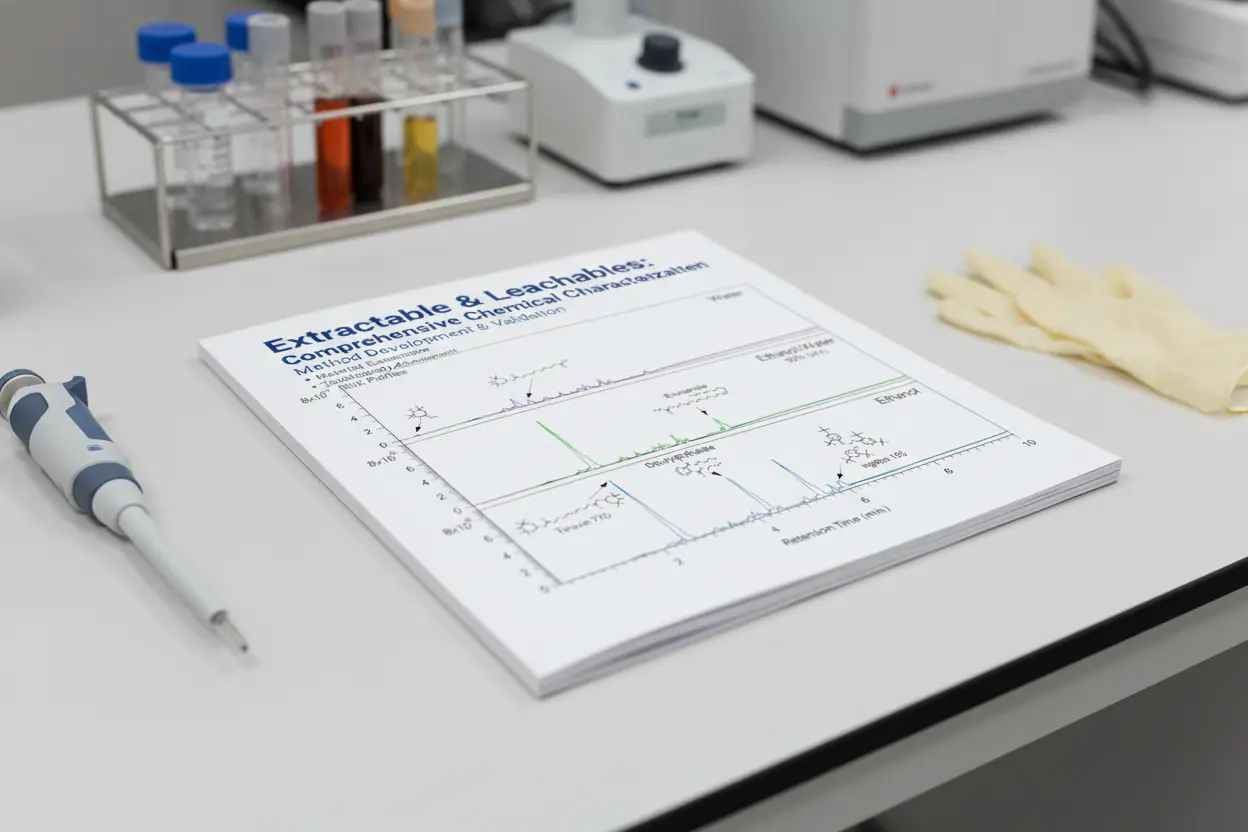
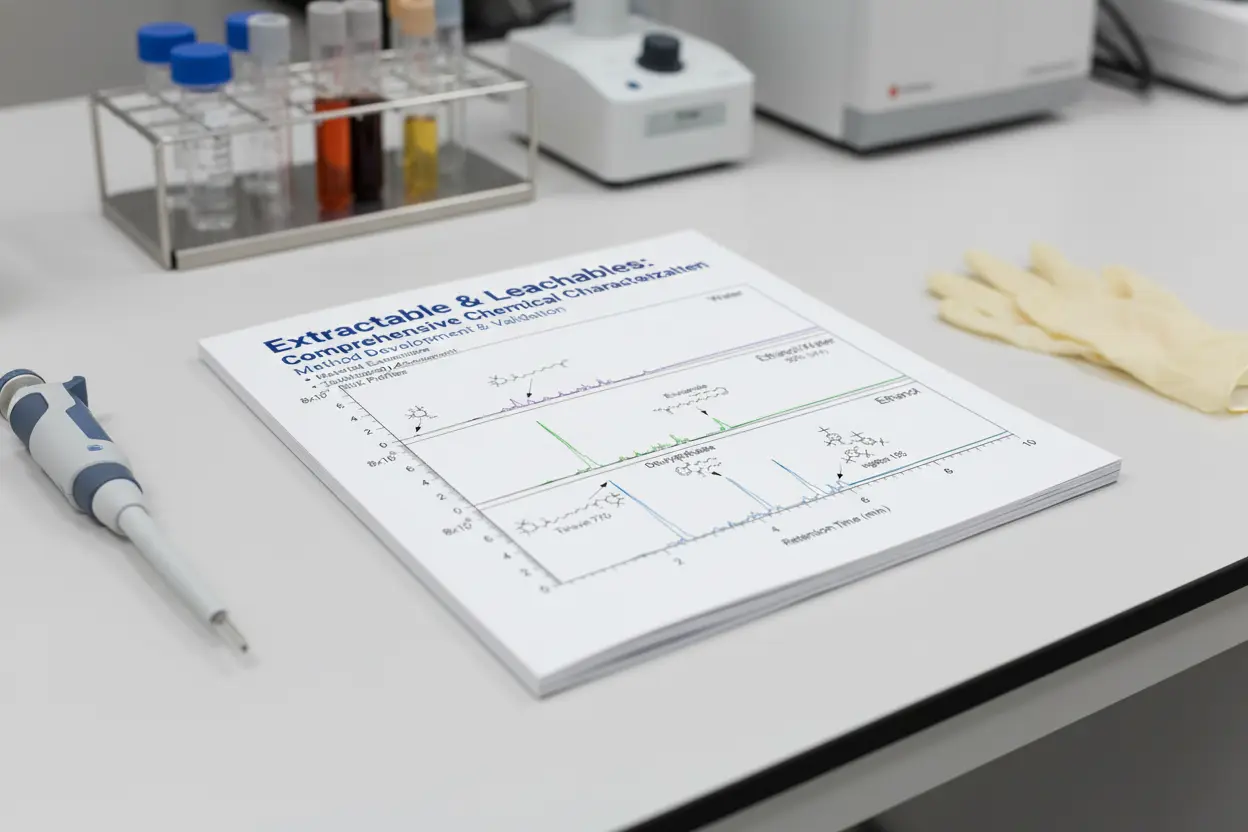
Chemva selected three bracketing solvents to span the drug product's pH and ionic strength envelope: a polar aqueous system (matched to drug pH), an intermediate-polarity alcoholic system, and a nonpolar organic system. For each solvent, Chemva specified both exhaustive (reflux or Soxhlet) and simulated (40°C/75%RH accelerated) extraction conditions, providing a defensible worst-case envelope.
Extraction duration was set to demonstrate asymptotic plateau in extractable recovery — typically 14, 21, and 28 days at 40°C for polymer components, with earlier time-points for elastomeric components where extraction kinetics are faster. Each solvent/condition combination was justified in writing against the drug product contact profile, creating a defensible rationale directly transferable to Module 3.2.P.7.
2. AET Derivation per USP <1663>
Chemva derived a drug-product-specific Analytical Evaluation Threshold (AET) using the Safety Concern Threshold (SCT) at 1.5 μg/day, adjusted for the drug's maximum daily dose and adjusted for analytical uncertainty using the PQRI PODP uncertainty factor approach. For this prefilled syringe at 1 mL/day maximum administered volume, the derived AET was 0.6 μg/mL, corresponding to an instrument reporting limit of approximately 0.1 μg/mL — well within the capability of modern GC-MS and LC-MS/MS systems.
The AET derivation was documented in a format directly transferable to IND/NDA Module 3.2.P.7 (Container Closure System), complete with a worked calculation, an SCT-to-AET derivation table, and a reviewer-facing sensitivity analysis across alternative daily dose scenarios.
3. Analytical Method Suite Specification
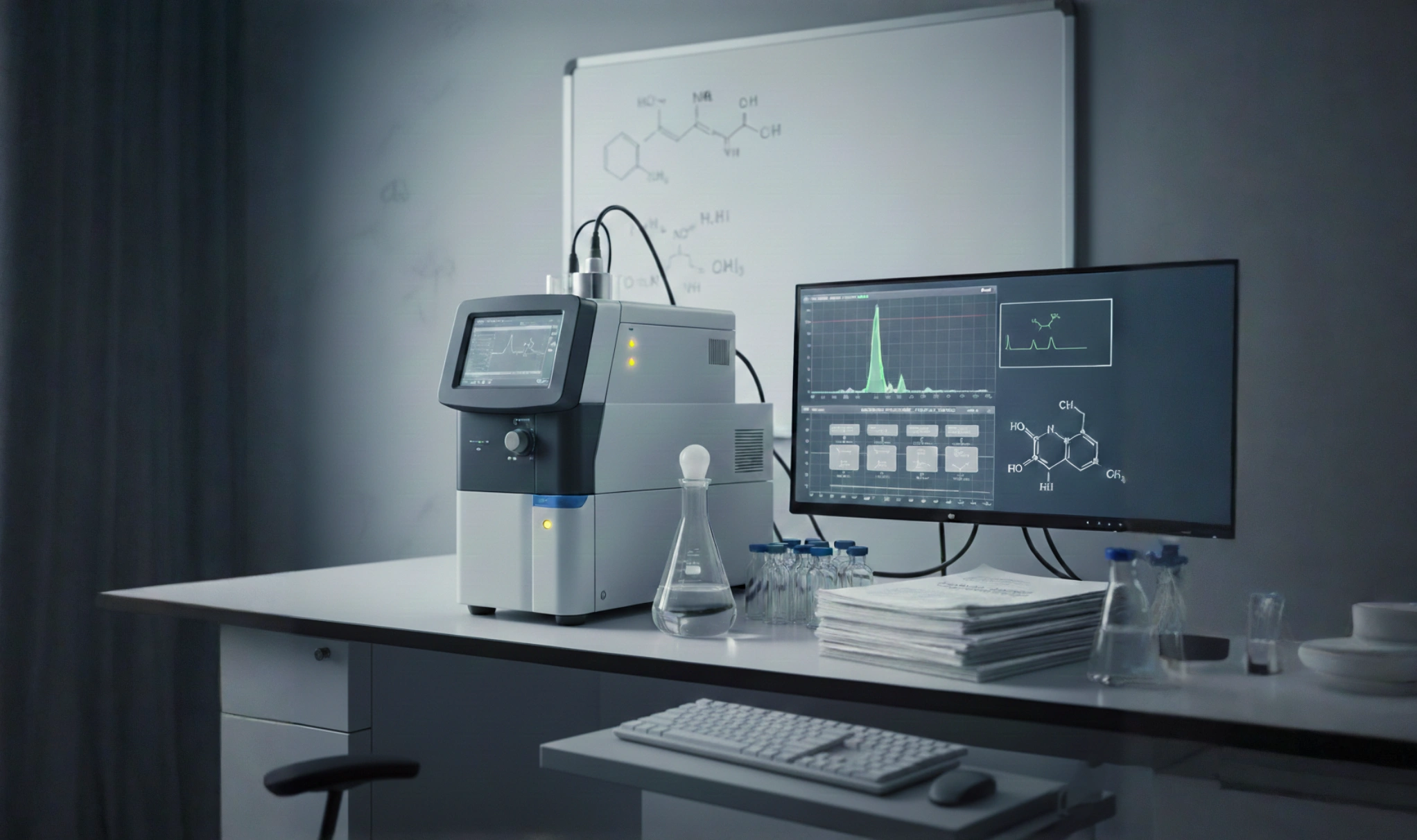
Chemva specified a complete analytical matrix covering all four extractable chemistry classes: (a) GC-MS for volatiles and semi-volatiles, (b) LC-MS/MS for non-volatiles, (c) ICP-MS for elemental impurities (harmonized with the cumulative ICH Q3D / USP <232> approach), and (d) headspace GC-MS for residual solvents. Each method was specified with matrix-matched reference standards, a compound confirmation strategy (retention time + mass spectrum library match + confirmatory ion ratio), and quantitation based on internal-standard response factors.
The analytical protocol explicitly addressed known nitrogen-containing leachables (amines, amides, N-nitroso species) — critical given the rising regulatory scrutiny of parenteral nitrosamine exposure and the cross-contamination risk from elastomeric closures.
4. Leachables Study Bridging Strategy
Chemva defined a bridging extractables-to-leachables correlation plan with time-point sampling across 0, 3, 6, 12, and 24-month stability intervals. For each time point, the drug product was to be analyzed using the same validated analytical suite used for extractables, with the transition from general-scan (untargeted) to validated target-compound methods triggered once the leachables profile stabilized (typically at the 6-month time point).
The bridging plan also specified go/no-go criteria for escalating any newly-detected leachable to a full toxicological risk assessment using Chemva's TRA methodology, closing the loop between analytical detection and safety assessment with a clearly-defined decision point.
Impact Delivered
- Chemva's E&L study design was executed by the sponsor's contract lab without protocol rework, avoiding an estimated 6–8 week delay in the NDA timeline.
- The extractables profile met FDA's expectations on first submission, with no information requests related to CCS chemistry — a meaningful result for a Category 1 high-risk parenteral submission.
- The design framework was adopted as the sponsor's standard operating template for parenteral drug product development, reducing downstream design time on two follow-on programs.
- Chemva's integrated design + interpretation approach preempted the analytical method revalidation costs that typically follow protocol deficiencies identified during FDA review.
Key Takeaways
E&L study design for high-risk parenteral CCS is not a generic checklist exercise. Solvent selection, extraction conditions, AET derivation, analytical method suite, and leachables bridging strategy must all be tailored to the specific drug product and CCS configuration — and they must be defensible against both USP <1663> / <1664> and FDA review practice before any lab work is commissioned.
A poorly-scoped E&L protocol is among the costliest mistakes in CCS qualification: once analytical resources are committed to a deficient protocol, the sponsor typically faces a choice between accepting a weak regulatory position, or repeating the study at significant cost and schedule delay. Chemva's E&L service line is built around design-first engagement, ensuring the study commissioned to the contract lab is the study that will survive FDA review on first pass.



.jpeg)


.jpeg)


.webp)


.png)
%201%20(1).png)
