

Challenge
A combination product sponsor was developing a wearable autoinjector pairing a metal-based dose actuator with a subcutaneously delivered biologic drug product. The regulatory submission required demonstrating compliance with both ICH Q3D (for the drug contribution to the patient's elemental impurity exposure) and USP <232> (for the device-contact elemental load), but the two frameworks apply different exposure assumptions and element class definitions.
Early regulatory feedback from FDA's Office of Combination Products indicated that submitting separate Q3D and <232> analyses would not satisfy reviewers — a unified cumulative Permitted Daily Exposure (PDE) model was required, accounting for contributions from both the device contact surface and the drug product over the full treatment duration. The sponsor's existing submission structure had treated the device and drug as independent streams, leaving no integrated cumulative safety argument for the reviewer.
Chemva was engaged to construct a defensible cumulative elemental impurity PDE model that harmonized the two frameworks, provided a single reviewer-facing narrative, and survived first-pass FDA review without a request for additional testing or analytical work.
Harmonizing ICH Q3D and USP <232>
Combination products sit at the intersection of two mature but separately-developed elemental impurity regimes. Understanding the technical differences between them is essential to building a cumulative model that satisfies both frameworks simultaneously.
ICH Q3D: Drug-Oriented, Exposure-Based
ICH Q3D(R2) defines Permitted Daily Exposure (PDE) values for 24 elemental impurities across three class tiers (Class 1: As, Cd, Hg, Pb; Class 2A: Co, V, Ni; Class 2B: Ag, Au, Ir, Os, Pd, Pt, Rh, Ru, Se, Tl; Class 3: Ba, Cr, Cu, Li, Mo, Sb, Sn). PDEs are route-specific — oral, parenteral, and inhalation — and represent the total daily exposure limit from the drug product, not from any single component.
USP <232>: Finished-Product Specification
USP <232> adopts PDE values aligned with ICH Q3D but is applied as a finished-product specification (Option 1: component PDE × maximum daily dose; Option 2a/2b: drug product limit) and is the governing chapter for device-contact extractable assessments under chemical characterization. Its companion chapter, USP <233>, specifies the ICP-MS and ICP-OES validation requirements.
Where Class Definitions Diverge
Despite the aligned PDE values, the two frameworks differ in operational definition in three ways that matter for combination products: (a) ICH Q3D applies the PDE against total patient exposure; USP <232> applies it against a per-component specification, which can mask cumulative contribution from multiple sources; (b) ICH Q3D's risk-based assessment allows elements to be excluded from routine testing if the risk is documented as negligible, whereas USP <232> requires analytical confirmation for all Class 1 and 2A elements regardless; (c) ICH Q3D is route-specific, whereas USP <232> defaults to the parenteral PDE unless the sponsor documents otherwise. A cumulative combination-product model must reconcile all three differences explicitly.
The Combination Product Gap
Neither standard directly addresses cumulative exposure from a combination product. For wearable or patient-contact device configurations, FDA expects the sponsor to sum device-contact leachable contribution + drug product elemental load + excipient contribution, then compare the cumulative daily exposure against the lower of the two reference PDEs. This cumulative approach is articulated in FDA's Office of Combination Products review practice but is still implemented inconsistently in sponsor submissions, which creates opportunity for reviewer pushback.
Chemva's Solution
Chemva constructed a cumulative elemental impurity risk model aligned with both ICH Q3D and USP <232>, implemented as a four-step integrated methodology delivered as a single submission-ready package.
1. Material-to-Element Mapping
Chemva began by assembling a complete material inventory of the combination product: device bill-of-materials (actuator alloy, housing polymer, adhesives, seals), drug-substance specification with elemental impurity historical test data, excipient certificates of analysis (CoA), and primary packaging contact data. Each element in ICH Q3D's 24-element table was mapped to its potential material source — for example, trace Co and Ni from the cobalt-chromium actuator alloy; Pb and Cu trace impurities from the excipient base; residual Pt from catalytic residues in the drug substance.
Where a single element could originate from more than one component (for example, Fe from both the actuator alloy and the drug substance), Chemva documented each contributing source independently and retained each entry in the cumulative model, rather than collapsing them into a single value — an approach that gives FDA reviewers full traceability from cumulative exposure back to root source material.
Elements not sourced from any component were documented as "not applicable" with supporting rationale — an important reviewer-facing exhibit that preempts the "why was element X not tested" question that commonly appears in FDA AI letters for combination products.
2. Extraction & Leachable Data Integration
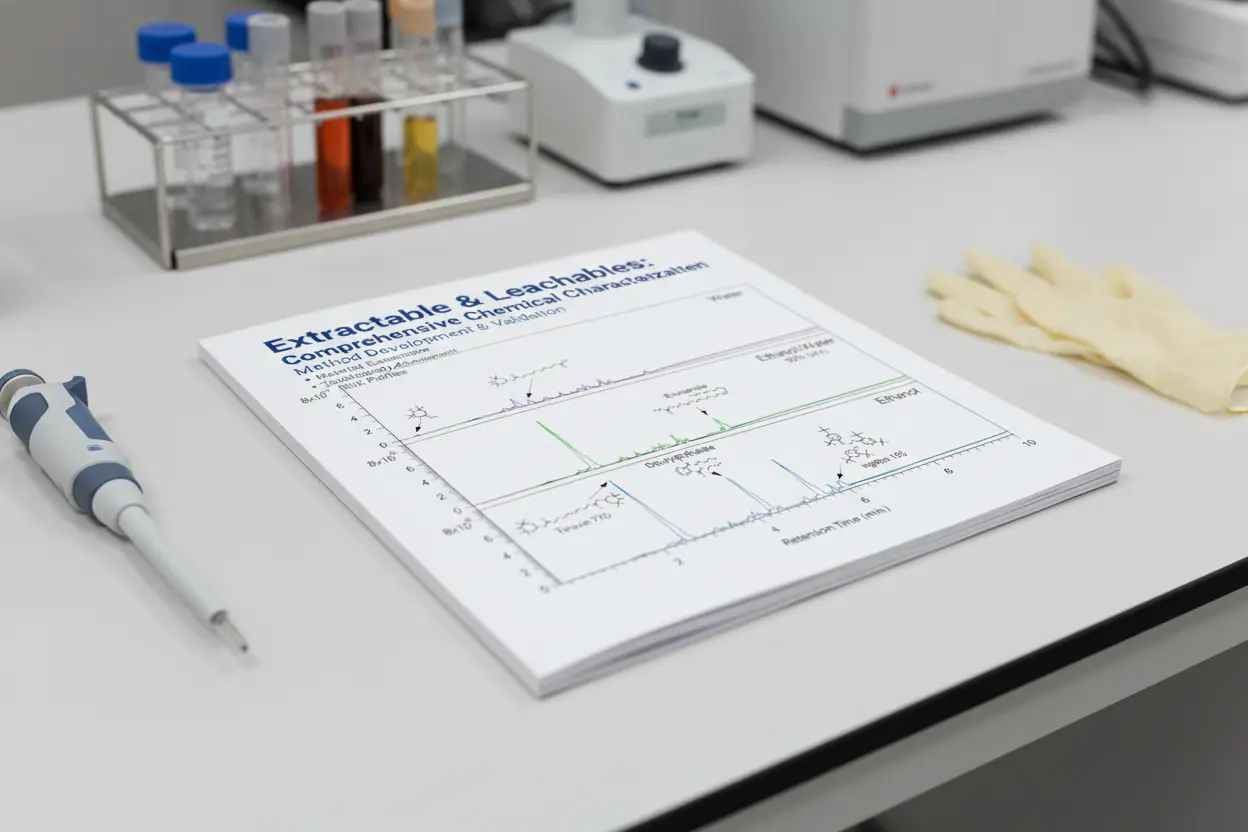
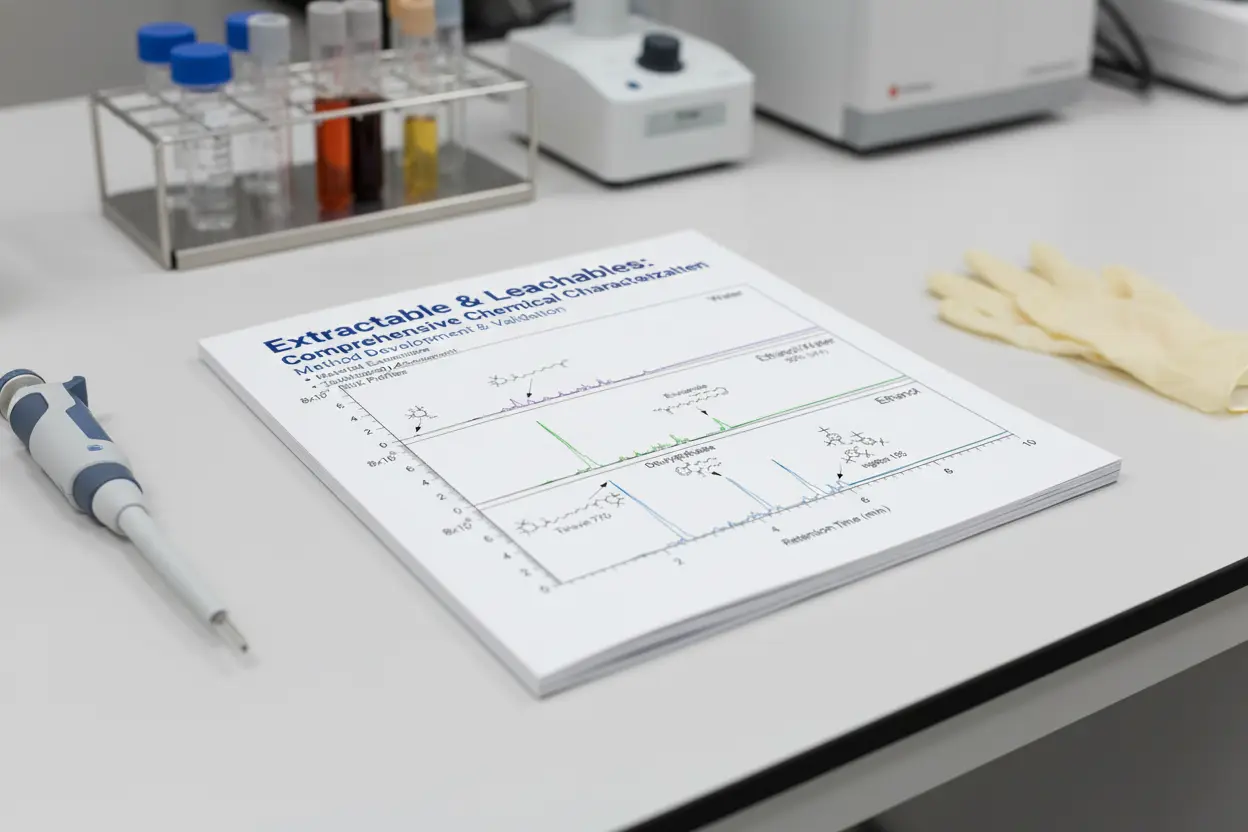
Chemva integrated existing ICP-MS extractable data from the device actuator, generated under ISO 10993-18 exhaustive extraction conditions at 50°C and 37°C in aqueous and ethanolic solvent systems. Where simulated-use leachable data was available, Chemva applied the measured leachable rate; where only extractable data existed, Chemva applied a conservative 100% leachable conversion factor as a worst-case bounding assumption.
For three elements with non-quantified extractable data (below the AET), Chemva applied a bounded extrapolation using the instrument quantitation limit × total device contact surface area, consistent with PQRI PODP recommendations on handling below-AET elements in a cumulative model.
3. Cumulative PDE Derivation
For each of the 24 Q3D elements, Chemva calculated cumulative daily exposure by summing three contribution streams: (a) device-contact extraction/leachable rate × treatment duration; (b) drug-product contribution = drug substance residual × daily dose; (c) excipient contribution from CoA data. The cumulative daily exposure for each element was compared against the lower of the ICH Q3D parenteral PDE and the USP <232> Option 1 limit — the binding constraint was documented for each element.
The resulting cumulative exposure table showed all 24 elements at less than 30% of their binding PDE, with the three closest — Ni, Co, and Cr — at 18%, 22%, and 28% respectively. A sensitivity analysis was prepared for these three elements, testing the effect of worst-case device extractable values and maximum daily dosing scenarios.
4. Submission-Ready Justification
The final deliverable was a unified ICH Q3D / USP <232> compliance narrative structured for FDA reviewer consumption: a single cumulative PDE margin table, a material-source traceability matrix, a sensitivity analysis for the three closest-to-limit elements, and a plain-language executive summary connecting the cumulative model to the patient's actual daily exposure during normal and worst-case device use.
Impact Delivered
- The cumulative PDE model was accepted by FDA's Office of Combination Products at the pre-submission meeting, with no request for supplementary elemental testing.
- The sponsor avoided parallel ICP-MS validation studies on the drug product, saving ~10 weeks of program time and preserving the 510(k) timeline.
- The harmonized Q3D/<232> framework Chemva built is now used as the sponsor's internal template across their combination-product portfolio, including three follow-on wearable-device programs.
- First-pass submission success reduced the sponsor's review-cycle burden and preserved the commercial launch window for the autoinjector platform.
Key Takeaways
Combination product sponsors should anticipate that reviewers will request an integrated cumulative PDE model that spans device-contact leachables, drug product elemental content, and excipient contribution — not three separate analyses presented in parallel. Submitting parallel streams without a cumulative synthesis is now a common reason for Additional Information requests at FDA's Office of Combination Products.
Getting the cumulative model right early in development is significantly cheaper than retrofitting it during submission. Chemva's integrated toxicology risk assessment and chemical characterization practice is designed around this combined-framework view for exactly this reason — building the cumulative model during development planning rather than during FDA response.




.jpeg)


.jpeg)


.webp)


.png)
%201%20(1).png)
